


Two black ginger bottles can both say "500 mg" and contain completely different things. The front of the label will not tell you which is which. The back will, if you know where to look.
By BoneScience Editorial · Sources checked against PubMed abstracts on November 5, 2026 · Last reviewed November 5, 2026
Check 1: powder or extract?
"Black ginger rhizome powder" is the dried, ground root. An "extract" has been treated with a solvent (usually ethanol or water) to pull out and concentrate the flavones, then dried. A gram of extract carries far more flavone than a gram of powder, which is why extract doses in trials are small.
Every placebo-controlled trial that measured a change in body fat used an extract or a purified flavone fraction. None used rhizome powder. If a label says only "black ginger" or "Kaempferia parviflora (root)" with no word "extract," assume powder.
Check 2: the three numbers on a standardized label
Polymethoxyflavones (PMFs) are the compounds black ginger research measures. A standardized extract names one or more of them with a minimum percentage. The three you will see:
| Number on the label | What it is | What a reasonable figure looks like |
|---|---|---|
| Total polymethoxyflavones, % | The whole flavone family together. | Sirtmax® is specified at 15% or more. |
| 5,7-dimethoxyflavone (DMF), % | The single most-quoted marker. | Sirtmax® is specified at 4% or more. In a 2019 human study, DMF was not detectable in blood after a dose, so DMF alone says more about the extract than about what reaches you. |
| 3,5,7,3',4'-pentamethoxyflavone (PMF), % | One of the two flavones that were measurable in blood after a dose in that same study (half-life 2 to 3 hours). | Sirtmax® is specified at 3 to 5%. |
A label with no percentage is not standardized, whatever the front says. A label with one percentage is better. What matters more than the size of any one number is whether the extract matches one that was tested in people, which brings us to check 3.
Check 3: was this extract actually tested?
Black ginger extracts differ in solvent, concentration and standardization, so a trial on one extract does not automatically apply to another. Here are the extracts that appear in placebo-controlled human trials, with the daily dose each trial used.
| Extract as named in the trial | Daily dose | Trial | What was measured |
|---|---|---|---|
| Sirtmax® (Tokiwa Phytochemical, Japan) | 100 mg | Sung 2025, 83 Korean adults, 12 weeks | Less body fat and visceral fat area than placebo. Waist and hip size unchanged. |
| KPFORCE™ (Japan) | 150 mg | Yoshino 2018, 76 Japanese adults, 12 weeks | Less abdominal fat area and lower triglycerides than placebo. |
| KPFORCE™ (safety study) | 750 mg | Yoshino 2019, 52 healthy adults, 4 weeks | No adverse events; blood and urine tests matched placebo. |
| Purified polymethoxyflavone from K. parviflora | 12 mg | Yoshino 2021, 80 Japanese adults, 12 weeks | Lower visceral fat area than placebo at weeks 8 and 12. |
| Standardized Thai extract (unbranded) | 180 mg | Promthep 2015, 60 soccer players, 12 weeks | Stronger right-hand grip; other fitness tests unchanged. |
| Standardized Thai extract (unbranded) | 360 mg | Sripanidkulchai 2022, 194 teenage athletes, 12 weeks | Stronger grip, higher VO2 max, faster 50-meter sprint. |
| Thai extract (unbranded) | 90 or 180 mg | Sripanidkulchai 2019, healthy adults, 28 days | Glucose tolerance test unchanged; flavones measurable in blood. |
| Thai extract (unbranded) | 25 or 90 mg | Wattanathorn 2012, 45 older adults, 8 weeks | Better chair-stand and 6-minute-walk scores. |
Two practical points. If a label names Sirtmax® or KPFORCE™, you can compare its per-serving amount directly to the trial dose above. If it names no extract, you cannot connect it to any trial, and the percentage figures from check 2 are all you have to go on.
Check 4: an amount on its own line
A "proprietary blend" lists several ingredients under one total weight. That is legal, and it means you do not know how much black ginger is in the capsule. Look for the black ginger extract on its own line of the Supplement Facts panel with its own milligram figure. The same goes for every other ingredient in the bottle.
Check 5: the Latin name, and the right plant
The plant is Kaempferia parviflora. Three names cause confusion on labels:
- Thai ginseng or krachai dam are traditional names for the same plant. Fine.
- Black turmeric is a trade name some suppliers use for K. parviflora, but botanical black turmeric is Curcuma caesia, a different plant with different compounds. Trust the Latin name on the panel.
- Black maca is Lepidium meyenii, an unrelated Andean root. No black ginger trial applies to it.
Check 6: who tested the finished product, and what they tested
A certificate of analysis (COA) is a lab report for one batch. Two things to know before you ask for one.
Who ran the tests. A manufacturer's COA comes from the company that made the capsules, using its own lab or a lab it hired. An independent-lab COA comes from a laboratory with no commercial tie to the seller. Both are legitimate documents; they are not the same thing, and a seller should say which one it is giving you. A seller that presents a manufacturer's report as independent testing is describing it wrongly.
What was tested. A useful COA for a black ginger product shows, for a named lot number: the measured amount of the extract per serving against its specification (ideally by HPLC), microbial counts (total aerobic count, yeast and mold, and named pathogens), and heavy metals (lead, arsenic, cadmium, mercury) against limits. A COA that lists only "passes" with no numbers tells you less.
Then match the lot number on the COA to the lot number printed on your bottle. A report for a different lot is a report for a different batch.
Check 7: the rest of the panel
- Serving size and servings per container. "90 capsules" can be 90 or 30 servings. Price per day is price divided by servings, not by capsules.
- Other ingredients. Capsule material, fillers and colorants are listed here. Nothing wrong with them; you should simply be able to see them.
- Warnings. Black ginger labels generally say not to use the product in pregnancy or while breastfeeding and to consult a healthcare provider if you take medication. A label with no warning at all is a label that skipped a step.
- The FDA disclaimer. Any structure or function statement ("supports…") must carry the standard FDA disclaimer; the asterisk is how a label points to it. If a label makes health claims without it, read the rest of the label with the same caution.
The checklist
- Extract, not rhizome powder.
- A percentage of polymethoxyflavones (total, DMF or PMF) on the panel.
- An extract that appears in a human trial, at a dose near what the trial used.
- Black ginger on its own line with its own milligram amount; no proprietary blend.
- Kaempferia parviflora by Latin name.
- A certificate of analysis for your lot, with the tester named honestly and numbers, not just "pass."
- Serving size, other ingredients, warnings and the FDA disclaimer all present.
Questions readers ask
- Is 500 mg of black ginger a lot?
- It depends on what the 500 mg is. If it is rhizome powder, it is a modest amount of a far less concentrated material. If it is a standardized extract, it is above every dose used in the 12-week body-fat trials (12 to 150 mg) and near the 750 mg used in a 4-week safety trial. The word "extract" and a percentage figure are what tell you which case you are in.
- What does "standardized to 5% DMF" mean?
- That each batch contains at least 5% 5,7-dimethoxyflavone by weight. It describes the extract's content. In a 2019 human study, DMF was not detectable in blood after a dose while two other flavones were, so a DMF figure is a quality marker for the extract rather than a measure of what reaches you.
- Is a manufacturer's certificate of analysis the same as independent testing?
- No. A manufacturer's COA is the maker's own testing. Independent (outside-lab) testing comes from a laboratory with no commercial tie to the seller. Both can be accurate; a seller should tell you which one it has.
- How do I check the lot number?
- It is printed on the bottle, usually near the expiration date. Ask the seller for the certificate of analysis for that lot, and compare the two numbers.
- Does the price per capsule matter?
- Price per day matters more. Divide the bottle price by servings per container, not by capsule count, and compare products that use the same extract at a similar dose.
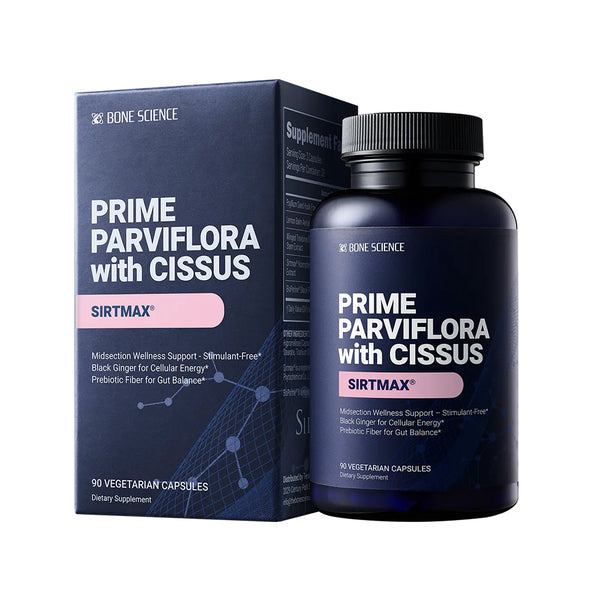
See Prime Parviflora
The studies above were not conducted on BoneScience products. The certificate of analysis is the manufacturer's own testing, not independent testing; check the lot number on your bottle. Sirtmax® is a registered trademark of Tokiwa Phytochemical Co., Ltd. BioPerine® is a registered trademark of Sabinsa Corporation.
Related: Black Ginger: What 10 Human Trials Actually Found · What Is Sirtmax®?
Sources
- Sung HK, et al. Front Nutr. 2025;12:1576024. PubMed · doi
- Yoshino S, et al. Diabetes Metab Syndr Obes. 2018;11:447-458. PubMed · doi
- Yoshino S, et al. J Med Food. 2019;22(11):1168-1174. PubMed · doi
- Yoshino S, et al. Food Funct. 2021;12(4):1603-1613. PubMed · doi
- Promthep K, et al. Med Sci Monit Basic Res. 2015;21:100-108. PubMed · doi
- Sripanidkulchai B, et al. J Diet Suppl. 2022;19(2):149-167. PubMed · doi
- Sripanidkulchai B, et al. Nutrients. 2019;11(5):1176. PubMed · doi
- Wattanathorn J, et al. Evid Based Complement Alternat Med. 2012;2012:732816. PubMed · doi
- Sirtmax® specification, Tokiwa Phytochemical. sirtmax.com
- Bactolac Pharmaceutical, Inc. Certificate of Analysis, Bone Science Parviflora Sirtmax Caps, lot 2511155, dated February 12, 2026 (manufacturer's testing).
*These statements have not been evaluated by the Food and Drug Administration. This product is not intended to diagnose, treat, cure, or prevent any disease. This article is for general education and is not medical advice.