


Black ginger is sold with big promises and a small body of evidence. So we did the slow part: we read every human trial we could find on PubMed, and wrote down what each one measured and what it did not.
By BoneScience Editorial · Sources checked against PubMed abstracts on November 5, 2026 · Last reviewed November 5, 2026
What black ginger is
Kaempferia parviflora is a plant in the ginger family grown in Thailand, where the dark purple rhizome is called krachai dam and sometimes "Thai ginseng." It is not the same plant as culinary ginger (Zingiber officinale), and it is not black turmeric (Curcuma caesia), although some suppliers use that name for it.
Polymethoxyflavones (PMFs) are the compounds researchers measure in black ginger. The three named most often on labels are 5,7-dimethoxyflavone (DMF), 5,7,4'-trimethoxyflavone (TMF) and 3,5,7,3',4'-pentamethoxyflavone (PMF). When a label says an extract is "standardized," it means the maker tested for one or more of these.
Black ginger has a long traditional use in Thailand. Traditional use is a reason to run a trial; it is not evidence of an effect.
What the human trials found
These are the placebo-controlled trials in people. Doses are the daily amount of extract used in each study, which differ from product to product, so compare the extract name, not just the milligrams.
| Study | Who and how long | Daily dose | What it found | What it did not find |
|---|---|---|---|---|
| Sung 2025 | 83 Korean adults with overweight (100 randomized), 12 weeks | 100 mg Sirtmax® (described by the authors as 50 mg of extract) | Body fat fell 338 g on average while placebo gained 305 g. Visceral fat area fell 11.2 cm² versus +0.4 cm². Body weight fell 1.1 kg versus 0.1 kg. | Waist and hip size did not differ from placebo. Lean mass also fell. Diet and exercise were not controlled. Funded by Daehan Chemtech; some authors work for the sponsor or for Tokiwa, the maker. |
| Yoshino 2018 | 76 Japanese adults with overweight, 12 weeks | 150 mg KPFORCE™ | Visceral, subcutaneous and total abdominal fat area and triglycerides fell more than placebo. No adverse events. | One center, Japanese adults only. |
| Yoshino 2021 | 80 Japanese adults with overweight, 12 weeks | 12 mg purified polymethoxyflavone | Visceral fat area was lower than placebo at weeks 8 and 12. | It tested a purified flavone fraction, not a whole-rhizome powder. |
| Yoshino 2019 | 52 healthy Japanese adults, 4 weeks | 750 mg KPFORCE™ | No adverse events; blood, urine and cardiovascular tests matched placebo. | A safety study only. Four weeks. |
| Promthep 2015 | 60 soccer players, 12 weeks | 180 mg Thai extract | Right-hand grip strength rose at weeks 4, 8 and 12. | Leg strength, sprint, agility, flexibility and cardiorespiratory fitness did not differ from placebo. |
| Sripanidkulchai 2022 | 194 teenage male athletes, 12 weeks | 360 mg Thai extract | Grip, back-leg strength and VO2 max rose; 50-meter sprint time fell. Blood tests stayed normal. | Flexibility and agility did not change. Teenage male athletes only. |
| Wasuntarawat 2010 | 19 and 16 college men, single dose | One dose 90 minutes before exercise | Nothing. | No change in sprint power, time to exhaustion, perceived effort or heart rate. |
| Wattanathorn 2012 | 45 healthy older adults, 8 weeks | 25 or 90 mg Thai extract | Chair-stand and 6-minute-walk scores rose; antioxidant enzymes rose. | Small study; the authors call for more. |
| Matsushita 2015 | Healthy men, single dose | One dose of ethanol extract | Energy expenditure rose for about an hour (peak +229 kJ/day), more in men with active brown fat. | An hour of extra calories burned is not a change in weight. |
| Sripanidkulchai 2019 | Healthy adults, 28 days | 90 or 180 mg Thai extract | Two flavones (PMF and TMF) were measurable in blood after a dose, with half-lives of 2 to 3 hours. DMF was not detectable. | An oral glucose tolerance test did not change at either dose. |
What the pooled reviews say
- A 2017 systematic review found 7 clinical studies out of 683 records. Grip strength rose in the two studies that measured it, and no adverse events were reported at doses up to 1.35 g a day. The reviewers called the evidence inconclusive because the studies were small.
- A 2024 meta-analysis pooled 57 articles, animal and human. In the human trials, fasting blood glucose fell slightly (a standardized mean difference of −0.51, with a confidence interval that nearly reaches zero). We read that as a lead for future trials, not a settled result; the 28-day glucose tolerance trial above found no change.
The test-tube result everyone quotes
Most black ginger marketing mentions sirtuins. That comes from a 2014 laboratory study in which a black ginger extract raised the activity of the SIRT1 enzyme in an assay dish, and two of its flavones were four to five times more potent than resveratrol in the same dish. It is a real result, and it is why one extract's maker describes it as a patented sirtuin activator. But no human trial has measured sirtuin activity after taking black ginger. A test-tube result tells you what to study in people; it does not tell you what happens in people.
Doses the trials used
| Daily amount | What it was | Trial |
|---|---|---|
| 12 mg | Purified polymethoxyflavone (not a whole extract) | Yoshino 2021, 12 weeks |
| 25 or 90 mg | Thai extract | Wattanathorn 2012, 8 weeks |
| 90 or 180 mg | Thai extract | Sripanidkulchai 2019, 28 days |
| 100 mg | Sirtmax® (Tokiwa) | Sung 2025, 12 weeks |
| 150 mg | KPFORCE™ | Yoshino 2018, 12 weeks |
| 180 mg | Thai extract | Promthep 2015, 12 weeks |
| 360 mg | Thai extract | Sripanidkulchai 2022, 12 weeks |
| 750 mg | KPFORCE™ (safety study) | Yoshino 2019, 4 weeks |
| Up to 1.35 g | Highest daily amount in the 2017 review | Saokaew 2017 |
Two things stand out. First, the effective doses in the fat trials were small: 12 to 150 mg of a standardized extract a day. Second, "500 mg of black ginger" on a label usually means 500 mg of dried rhizome powder, which is not the same thing as 100 mg of an extract standardized to 15% flavones. Our label guide, linked below, explains how to tell them apart.
Safety so far
Across the trials above, no study reported adverse events linked to black ginger, up to 750 mg of standardized extract a day for 4 weeks and 1.35 g a day in the 2017 review. In the 2025 Sirtmax® trial, about half of each group reported some adverse event, with no difference between extract and placebo, and hemoglobin fell slightly in the extract group while staying in the normal range. The gaps matter as much. No trial ran longer than 12 weeks. None studied pregnant or breastfeeding women or people taking prescription medicines, and the only participants under 18 were the teenage athletes in one trial. Product labels say not to use it in pregnancy or while breastfeeding. If you take medication, ask your healthcare provider first.
Reading a black ginger label in 20 seconds
- Powder or extract? "Rhizome powder" is the dried root. The trials above used extracts.
- Standardized to what? Look for a percentage of total polymethoxyflavones or 5,7-dimethoxyflavone. No number means no standardization.
- Which extract? If it names an extract that was in a trial (Sirtmax®, KPFORCE™), the dose per serving should be near what that trial used.
- Every amount listed? A "proprietary blend" hides how much black ginger you get.
The full checklist, including the three numbers on a standardized label and a table of which extracts were actually tested, is in How to Read a Black Ginger Supplement Label.
Questions readers ask
- Does black ginger really work?
- For body fat, three 12-week placebo-controlled trials in adults with overweight measured less abdominal or body fat than placebo, with changes of roughly a third of a kilogram of fat and about 11 cm² of visceral fat area in the largest trial. For grip strength, two 12-week trials in athletes found an increase. A single dose did nothing for exercise performance. Everything else is either a small study or a test-tube result.
- Can you take black ginger every day?
- The trials gave it once a day for 4 to 12 weeks without adverse events linked to the extract. Nobody has studied daily use for longer than 12 weeks.
- What are the side effects of black ginger?
- None were attributed to black ginger in the trials above, including a 4-week safety trial at 750 mg a day. In the 2025 trial, hemoglobin fell slightly within the normal range in the extract group. Labels say not to use it in pregnancy or while breastfeeding, and to check with a healthcare provider if you take medication.
- How much black ginger per day?
- The fat trials used 12 mg of purified flavones, 100 mg of Sirtmax® or 150 mg of KPFORCE™ a day. The athlete trials used 180 and 360 mg of a Thai extract. Match the extract, then match the dose; milligrams of one extract do not translate to another.
- Is black ginger the same as black maca?
- No. Black maca is the root of Lepidium meyenii, a plant in the mustard family from the Andes, with different compounds. None of the trials above tested maca, so nothing here applies to it.
- What is Sirtmax®?
- A branded black ginger extract from Tokiwa Phytochemical in Japan, standardized to at least 15% total polymethoxyflavones. It is the extract used in the 2025 Korean trial. We explain it in What Is Sirtmax®?
- Why is black ginger so expensive?
- A standardized extract starts from dried rhizome, is extracted with solvent, concentrated, and tested for flavone content before it is sold. Each step costs more than drying and grinding the root, which is why a standardized extract costs more per gram than rhizome powder, and why the two should not be compared by weight.
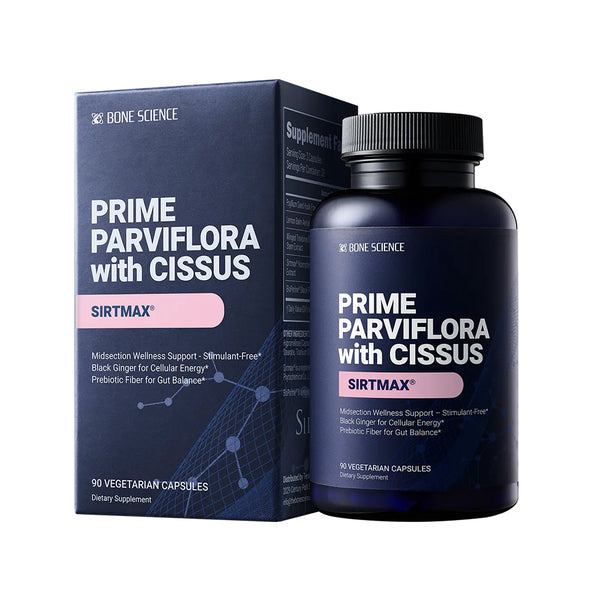
See Prime Parviflora
The studies above were not conducted on BoneScience products. Prime Parviflora combines Sirtmax® with other ingredients, and the finished product has not been tested in a clinical trial.
Related: What Is Sirtmax®? The Black Ginger Extract Behind the 2025 Trial · How to Read a Black Ginger Supplement Label
Sources
- Sung HK, et al. Front Nutr. 2025;12:1576024. PubMed · doi
- Yoshino S, et al. Diabetes Metab Syndr Obes. 2018;11:447-458. PubMed · doi
- Yoshino S, et al. Food Funct. 2021;12(4):1603-1613. PubMed · doi
- Yoshino S, et al. J Med Food. 2019;22(11):1168-1174. PubMed · doi
- Promthep K, et al. Med Sci Monit Basic Res. 2015;21:100-108. PubMed · doi
- Sripanidkulchai B, et al. J Diet Suppl. 2022;19(2):149-167. PubMed · doi
- Wasuntarawat C, et al. J Sports Sci. 2010;28(11):1243-1250. PubMed · doi
- Wattanathorn J, et al. Evid Based Complement Alternat Med. 2012;2012:732816. PubMed · doi
- Matsushita M, et al. J Nutr Sci Vitaminol (Tokyo). 2015;61(1):79-83. PubMed · doi
- Sripanidkulchai B, et al. Nutrients. 2019;11(5):1176. PubMed · doi
- Saokaew S, et al. J Evid Based Complementary Altern Med. 2017;22(3):413-428. PubMed · doi
- Na Takuathung M, et al. Nutr Res. 2024;122:80-91. PubMed · doi
- Nakata A, et al. Nat Prod Commun. 2014;9(9):1291-1294. PubMed
- Sirtmax® specification, Tokiwa Phytochemical. sirtmax.com
*These statements have not been evaluated by the Food and Drug Administration. This product is not intended to diagnose, treat, cure, or prevent any disease. This article is for general education and is not medical advice.