


If you have searched for a black ginger supplement, you have probably seen the advice to look for "Sirtmax" on the label. Here is what that word means, where it comes from, and what the one human trial on it did and did not show.
By BoneScience Editorial · Sources checked against PubMed abstracts and the maker's specification on November 5, 2026 · Last reviewed November 5, 2026
What is in the name
Sirtmax® is named after sirtuins, a family of enzymes. In a 2014 laboratory study, a black ginger extract raised the activity of the SIRT1 enzyme in an assay dish by 8-fold at 20 micrograms per milliliter and 17-fold at 100, and two of its flavones were four to five times more potent than resveratrol in the same dish. The maker says the extract is patented in the United States and Japan as a sirtuin activator, which describes that kind of laboratory property.
A test-tube result is a property of the extract, not an effect in your body. No human trial has measured sirtuin activity after taking black ginger, and the one human trial on Sirtmax® did not try to. Keep the two apart when you read a label.
What the maker standardizes it to
Standardization means the maker tests each batch for named compounds and sets minimum amounts. For Sirtmax®, the published specification is:
| Compound | Specification | Why it matters |
|---|---|---|
| Total polymethoxyflavones | At least 15.0% | The flavone family that black ginger research measures. |
| 5,7-dimethoxyflavone (DMF) | At least 4.0% | The single marker most labels quote. |
| 3,5,7,3',4'-pentamethoxyflavone | 3.0 to 5.0% | One of the two flavones that were measurable in human blood in a 2019 pharmacokinetic study. DMF was not. |
The raw material is the rhizome of Kaempferia parviflora. The maker's site also calls the plant "black turmeric," a trade name that is botanically a different plant (Curcuma caesia); on a label, the Latin name is the one to trust.
The 2025 trial, in numbers
Sung and colleagues published the trial in Frontiers in Nutrition in 2025. It is the only placebo-controlled trial of Sirtmax® itself on PubMed.
| Item | What the paper reports |
|---|---|
| Who | Korean adults aged 19 to 60 with a BMI of 25 to 30. 108 screened, 100 randomized, 83 analyzed (40 Sirtmax®, 43 placebo). |
| Dose | One capsule a day before breakfast containing 100 mg of Sirtmax®, which the authors describe as 50 mg of K. parviflora extract. |
| Length | 12 weeks. |
| Body fat (DEXA) | −338 g with Sirtmax® versus +305 g with placebo. |
| Visceral fat area (CT) | −11.2 cm² versus +0.4 cm². |
| Body weight | −1.08 kg versus −0.12 kg. |
| Lean mass | Fell in both groups (−588 g versus −297 g); the difference was not significant. |
| Waist and hip | No difference from placebo. |
| Adverse events | About half of each group reported some event, with no difference between groups. One serious event (a traffic accident) was judged unrelated. |
| Blood tests | Hemoglobin fell slightly in the Sirtmax® group and stayed within the normal range. |
| Diet and exercise | Not controlled; participants kept their usual habits. |
| Funding | Daehan Chemtech, a Korean company; three authors are its employees and one works for Tokiwa, the maker. |
How to read that: a difference of about 640 g of body fat between groups over 12 weeks is real but modest, and it came with a sponsor on the author list and no control of diet. It is one trial. The two earlier Japanese 12-week trials on a different black ginger extract (KPFORCE™, 150 mg a day) and on purified polymethoxyflavones (12 mg a day) point the same way, which is the main reason to take the result seriously. Our evidence guide, linked below, lays all ten human trials side by side.
What the trial did not test
- Any dose other than 100 mg a day, and any length other than 12 weeks.
- Sirtuin activity, energy, aging or any outcome other than body composition and blood tests.
- Combinations. Products that mix Sirtmax® with other ingredients, including ours, were not in the trial.
- Adults with a BMI under 25 or over 30, people over 60, or anyone outside Korea.
Is the dose in a product the same as in the trial?
Only the label can tell you. Three checks:
- The word Sirtmax® appears in the Supplement Facts panel, not just in marketing text, and it is spelled as a trademark. Products that say "black ginger extract" without a brand may be a different extract with a different standardization.
- Milligrams of Sirtmax® per serving are stated. The trial used 100 mg a day. A product near that amount is in the range that was tested; a product far below it is not.
- The amount is its own line, not part of a "proprietary blend." A blend total does not tell you how much Sirtmax® you get.
Because the trial used 100 mg of Sirtmax® and described it as 50 mg of extract, you will see both numbers quoted online. Compare the Sirtmax® figure on a label to the 100 mg figure.
Questions readers ask
- Who makes Sirtmax®?
- Tokiwa Phytochemical Co., Ltd., a botanical extract maker in Chiba, Japan. It is produced under GMP and HACCP according to the maker.
- Is Sirtmax® black ginger or black turmeric?
- Black ginger. The plant is Kaempferia parviflora. Some sellers, including the maker's own site, call it black turmeric, but botanical black turmeric is Curcuma caesia, a different plant.
- What dose of Sirtmax® was studied?
- 100 mg a day for 12 weeks, taken once before breakfast, in the 2025 Korean trial. The authors describe that 100 mg as 50 mg of K. parviflora extract.
- Does Sirtmax® activate sirtuins in people?
- That has not been measured in people. The sirtuin result is from a test-tube enzyme assay.
- Is Sirtmax® safe?
- In the 12-week trial, adverse events were as common with placebo as with Sirtmax®, and blood tests stayed in the normal range. Nobody has studied it for longer than 12 weeks. Labels say not to use it in pregnancy or while breastfeeding, and to ask a healthcare provider if you take medication.
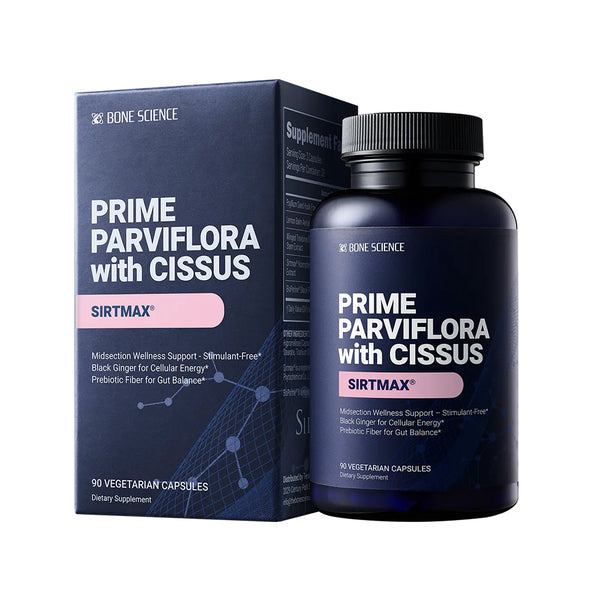
See Prime Parviflora
The studies above were not conducted on BoneScience products. Prime Parviflora combines Sirtmax® with other ingredients, and the finished product has not been tested in a clinical trial. The certificate of analysis is the manufacturer's own testing; your bottle may be from a different lot. Sirtmax® is a registered trademark of Tokiwa Phytochemical Co., Ltd.
Related: Black Ginger: What 10 Human Trials Actually Found · How to Read a Black Ginger Supplement Label
Sources
- Sung HK, et al. Front Nutr. 2025;12:1576024. PubMed · doi (open access; dose, per-group changes and funding are from the full text)
- Nakata A, et al. Nat Prod Commun. 2014;9(9):1291-1294. PubMed
- Sripanidkulchai B, et al. Nutrients. 2019;11(5):1176. PubMed · doi
- Yoshino S, et al. Diabetes Metab Syndr Obes. 2018;11:447-458. PubMed · doi
- Yoshino S, et al. Food Funct. 2021;12(4):1603-1613. PubMed · doi
- Sirtmax® specification, Tokiwa Phytochemical. sirtmax.com
- Bactolac Pharmaceutical, Inc. Certificate of Analysis, Bone Science Parviflora Sirtmax Caps, lot 2511155, dated February 12, 2026 (manufacturer's testing).
*These statements have not been evaluated by the Food and Drug Administration. This product is not intended to diagnose, treat, cure, or prevent any disease. This article is for general education and is not medical advice.