


Here is a question most parents have never been asked: does your teen get the calcium in four cups of milk, every single day? If the answer is "probably not", you are in good company, and the reason it matters comes with a timeline.
The bone bank is 90% full by 17
By the time the teenage growth spurt ends, most of the bone a person will ever have is already in place. The U.S. National Institutes of Health notes that about 90% of adult bone mass is built by around age 17. A systematic review on peak bone mass reached a practical conclusion: what children and teens eat, and how active they are, shapes the bone they carry into adulthood.

What 1,300 mg looks like on a plate
Most of a teen's calcium should come from food. The richest everyday sources are dairy, calcium-fortified soy milk and juices, canned fish eaten with the soft bones, and tofu made with calcium. Several servings a day are usually needed, which is exactly where busy schedules, skipped breakfasts and picky eating get in the way.
The timing problem most families miss
Calcium and iron compete. In a classic study of 126 people, adding 300 to 600 mg of calcium to a meal reduced iron absorption by 50 to 60%. For active teens, especially girls who have started their periods, iron matters too.
Iron
Calcium
| Time | Better paired with | Keep apart from |
|---|---|---|
| Morning | Iron-rich foods, vitamin C | Large calcium doses |
| Evening | Calcium, magnesium, vitamin K2 | Iron supplements |
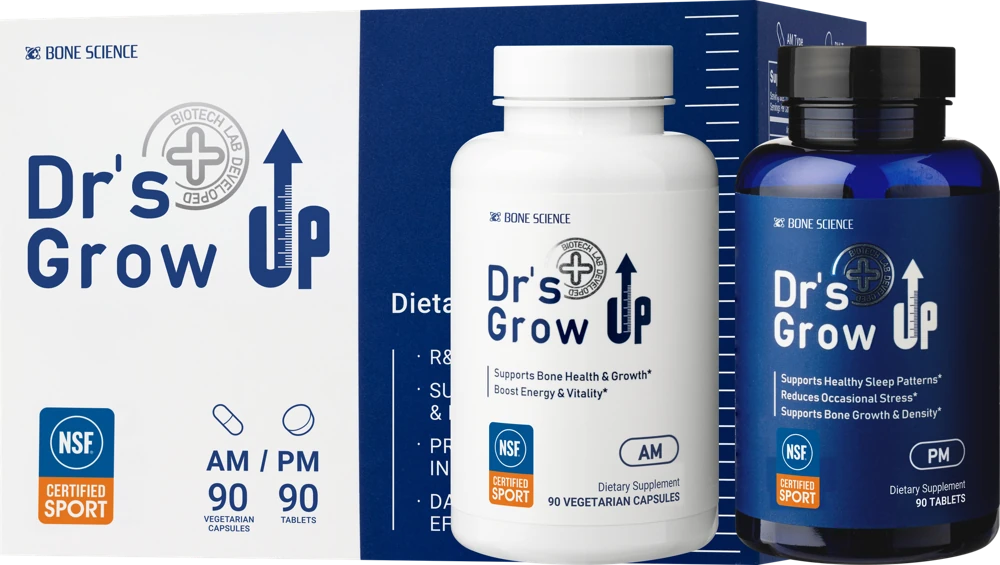
This is the reason Dr's Grow UP is split into two formulas: iron and zinc in the morning, calcium and magnesium at night.
See what's inside
Questions parents ask
- Can my teen get enough calcium from food alone?
- Often, yes, with several dairy or fortified servings every day. A supplement only fills the gap that remains.
- Is more calcium always better?
- No. There is an upper limit for every age group. Count food and supplements together, and ask your doctor if you are unsure.
- Does vitamin D matter here?
- Yes. Vitamin D helps the body absorb calcium, which is why it is usually paired with calcium in bone-focused formulas.
Next in Growing Years Science: How we check every number on our label · 8 important nutrients for bone density
- NIH Office of Dietary Supplements. Calcium — Health Professional Fact Sheet.
- NICHD, U.S. National Institutes of Health. Osteoporosis prevention begins in childhood.
- Weaver CM, et al. The National Osteoporosis Foundation's position statement on peak bone mass development and lifestyle factors: a systematic review and implementation recommendations. Osteoporos Int. 2016. doi:10.1007/s00198-015-3440-3
- Hallberg L, et al. Calcium: effect of different amounts on nonheme- and heme-iron absorption in humans. Am J Clin Nutr. 1991;53(1):112-9. doi:10.1093/ajcn/53.1.112
*These statements have not been evaluated by the Food and Drug Administration. This product is not intended to diagnose, treat, cure, or prevent any disease. This article is for general education and is not medical advice.